June 15th Is Coming. Here’s What Actually Happens.
June 15th after sophomore year is the first day a college coach can pick up the phone and call you. Here is the day, from both sides of the phone.
June 15th after sophomore year is the first day a college coach can pick up the phone and call you. It is the most anticipated date on the recruiting calendar, and the most misread.
The part nobody warns you about is not the phone call. It is the waiting. A phone face up on the counter, checked more times in an hour than in the whole week before. A teammate posting a screenshot in the group chat. And a sixteen-year-old at the kitchen table, trying very hard to look like she is not waiting.
That morning happens in thousands of houses at once, and most of those families are reading it completely wrong. Here is the day, from both sides of the phone.
What June 15th actually is
It is the first date that Division I and Division II coaches can recruit you directly. That word is doing a lot of work.
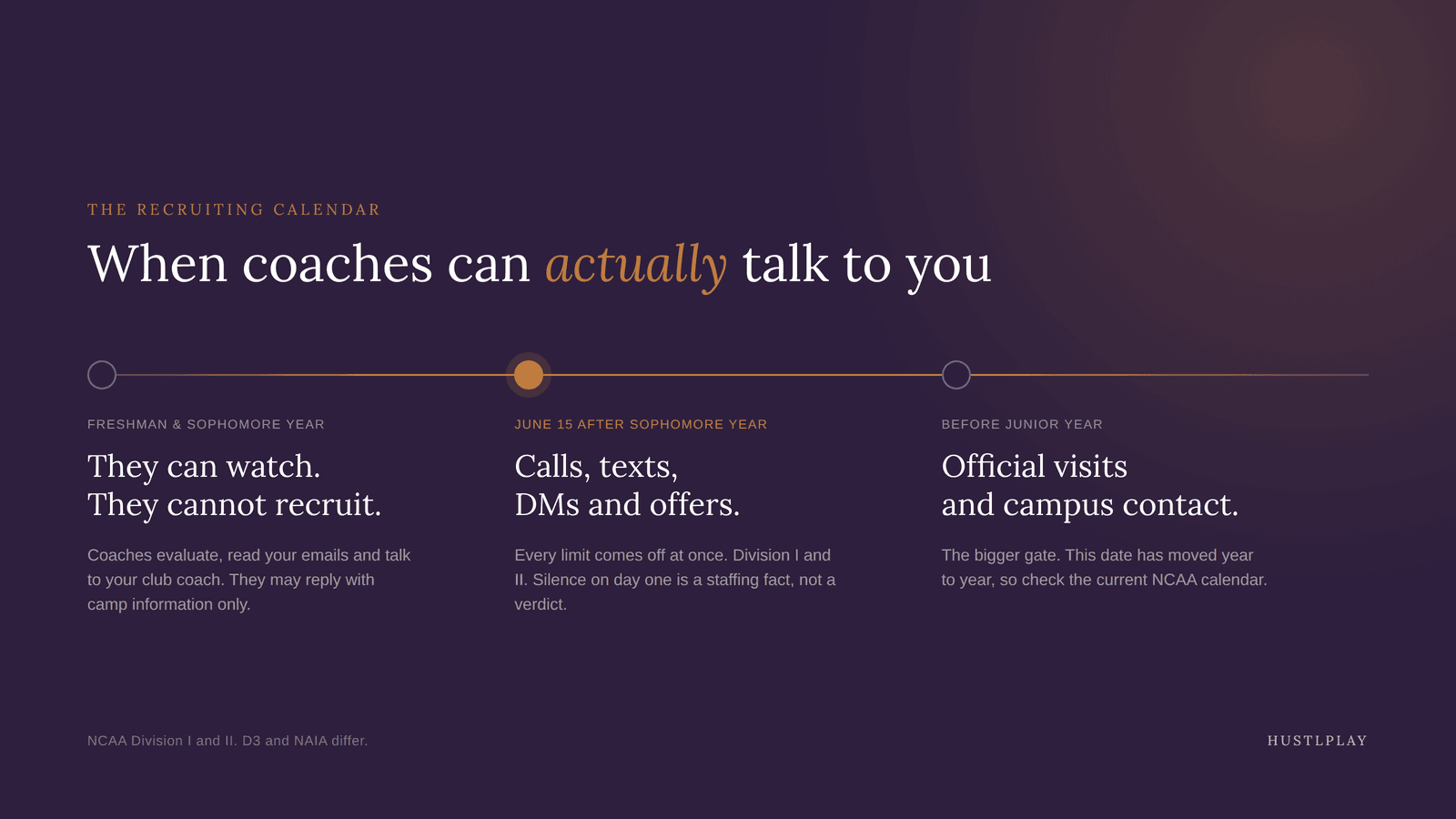
Before June 15th, coaches can watch you, evaluate you, read your emails and talk to your club coach. They can also write back, within narrow limits: a thank-you, general information about the school, and camp details. What they cannot do in that reply is recruit you. No evaluation, no read on where you fit, no conversation about your future there.
Coaches do reply, and those replies get misread in both directions. A standard one looks close to this:
Thank you so much for reaching out and sending this information, we appreciate it. As you know, due to NCAA rules we are very limited in what we can share with prospective student-athletes in your graduation year. We can share camp information. We have added an ID camp on February 21, which includes a facilities tour, a Q&A with current players and 11v11.
That is not a brush-off, and it is not a signal of serious interest either. It is a coach following the rule. The part worth acting on is the camp, which is one of the few legal ways a program can get a real look at you before the gate opens.
On June 15th the limits come off at once. Coaches can call, text, DM and email freely, send recruiting materials, and extend a verbal scholarship offer. That is the whole rule. It is a date on which recruiting becomes legal. It is not a date on which anyone is required to use it.
What is happening on the other end
Every program has been building a board for months, at showcases and ID camps, on film, through club coaches. By June 15th they have ranked the class and identified their Tier 1 prospects, usually fifty to eighty players.
Now consider the staff making those calls. Many programs have a head coach and one or two assistants, and those same people are finishing the class ahead of yours, working the transfer portal and running summer operations. Fifty to eighty calls, three people, and a week that is already full. Most staffs do not get through their Tier 1 list in the first week.
So when your phone does not ring at 7:03, the most likely explanation is not that you are unwanted. It is that you are number forty on a list a coach is working through between film sessions. Silence can also mean a coach wants one more look before starting a conversation, or that a transfer is arriving at your position and nobody knows yet how that shakes out.
It can mean a program has moved on. That happens, and it is survivable. Programs recruit to their needs, and a staff that already has three center backs in the class ahead of you is not evaluating your ability, it is counting its roster.
What silence never means is that the process is over. Almost nobody’s recruiting ends up looking anything like it did on that first morning, and the players who end up happiest are routinely not the ones whose phones rang first.
What a first contact usually looks like
Probably a text, a direct message or a short email. The goal is almost never an offer. It is to set up a call.
On that call a coach will introduce the program, describe the class they are building, and try to find the next time they can see you play. They will ask what you want out of college, what you do outside soccer, what you are working on in your game. They are trying to find out who you are.
Offers do come on June 15th. They used to be genuinely rare and that is no longer the right word, because this past cycle a lot more went out inside the first week than families expected. Still not the common outcome, but go in prepared for it.
If one comes, you do not have to answer in the moment, and no good coach expects you to. “Thank you, that means a lot, I would like to talk it through with my family” is a complete and respectful response.
How to prepare before June 15th
All of this belongs to the weeks before the 15th, not the morning of.
Send your emails in the week before. Coaches cannot write back about recruiting yet, but they can read. Landing in the inbox between roughly June 5th and June 13th means you are already there when the gate opens.
Set up a dedicated recruiting email. Plain and permanent, firstname.lastname.gradyear, shared with a parent. Every coach, camp and eligibility form will use it for three years.
Record a voicemail greeting and fix your signature. A real greeting with your name in it, and a signature carrying full name, graduation year, position, cell number and a link to current video. Post the video where it already lives, on Hudl or YouTube, and link to it. Nobody wants an attachment.
Register with the NCAA Eligibility Center. It has to happen before official visits, and it is easier now than in a panic the week a visit gets scheduled.
Sit down with your club coach. Before the 15th, not after. Tell them which programs are on your list and which you have emailed. College coaches call club coaches, and yours cannot say a useful word about you to a program that does not know you are interested. Highest-leverage twenty minutes on this list, and the one most often skipped.
Decide, as a family, what the boundaries are. When you take calls. Whether a parent sits in. When the phone goes away at night.
Once it starts, go back to work
The preparation ends on June 14th. What follows is a long stretch of ordinary days with the occasional phone call in them, and the players who handle it well treat it that way.
Keep your club coach current. Not once, continuously. Who reached out, who you talked to, which programs you are actually excited about. A club coach who finds out in October that you have been talking to a program since June could not help you for four months.
Answer what comes in. Promptly, in full sentences, including the ones where the answer is no thank you.
Then go train. Nothing about June 15th changed what gets you recruited, which is how you play. Every program that contacts you will watch you again, and some that did not will watch you for the first time. A summer spent refreshing a phone is a summer not spent getting better.
Parents: your job here is logistics and boundaries, not pressure. How often you ask whether anybody called is the one variable in this process entirely within your control.
The next gate is bigger than this one
June 15th gets the attention, but the gate that opens before junior year is where it gets real. That is when official visits can begin, off-campus contact is allowed, and schools can help with a parent’s travel costs.
One warning: that date moves. Families repeat whatever day it fell on for the class ahead of them, and it has not been the same every year. Check the current NCAA calendar.
Official visits are now unlimited and fully paid and can include a parent, but not every program has the budget to use them that way. An invitation to an unofficial visit or a camp is not a lesser signal. It is often just how a staff gets you on campus sooner.
How HustlPlay fits in
We built this because the alternative is what most families end up with: a spreadsheet, a notes app, three email threads, and whatever anybody happens to remember.
The Calendar holds the dates that matter, including the ones you did not know to look for, and sets the reminders that go with them. Compose and Email Templates get your pre-June-15 emails out without rewriting the same note forty times.
What it will not do is tell you which school is right. It never scores a school for you. You score them. That is the entire point.
Recruiting is hard. This part doesn’t have to be.
Recruiting contact rules differ by division. The dates above apply to NCAA Division I and Division II. Division III and NAIA programs operate under different rules and can generally contact players earlier.
Free to look around: build your profile, browse every program, and answer your negotiables. Subscribe when you are ready to contact coaches.