There Are About 1,600 Programs. Start With Seven Questions.
A list of 1,600 programs is not a list, it is a wall. Seven questions, none of them about soccer, turn it into one a family can work with.
There are about 1,600 college programs where you could play soccer.
That number is supposed to feel like good news. For most families it feels like the opposite. A list of 1,600 is not a list, it is a wall. And the way most families react is to shrink it in the fastest way available, which is to start with the programs they have heard of. Twelve schools, all Division I, all names you would recognize from television, most of them nowhere near a realistic fit.
We did that. Almost everybody does that. It is not a character flaw, it is what happens when nobody gives you a better first move.
Here is the better first move. Seven questions. Not about soccer.
Why the first cut is not about soccer
The instinct is to sort by level. Division I at the top, everything else underneath, and work down the ladder until somebody says yes.
That ladder is why so many players end up somewhere they are miserable. It optimizes for one variable, the badge on the jersey, and ignores the other four years of your life. You will spend roughly nine hundred hours on a soccer field. You will spend the other thirty thousand being a college student in a particular town, at a particular size of school, a particular distance from home, paying a particular amount of money.
So the first cut is not “where am I good enough to play.” It is “where would I actually want to be.” The soccer question comes second, and it is a much easier question to answer once the list is a hundred schools instead of sixteen hundred.
The seven questions
Every one of them has a “doesn’t matter to me” answer, and taking it is a real choice rather than a cop-out. A question you have no opinion on should not be quietly filtering your list.
1. What levels are actually on the table?
NCAA Division I, Division II, Division III, NAIA, junior college. Be honest here, and be broader than feels comfortable. Most families write off everything below Division I before they have watched a single Division II or NAIA game, which is a decision made on a logo rather than on soccer. A good Division II program will beat a bad Division I program, and the player at the good program plays.
If you genuinely do not know where you fit, keep more levels on than you think you need. You can always cut later. You cannot recover a program you never looked at.
2. How far from home do you want to be?
Drivable. A short flight. Anywhere.
This one is about you, not about logistics. Some players want home close enough to reach on a bad week, and knowing the people they love can get there in an afternoon is the thing that makes everything else possible. Others have wanted distance since they were twelve, and putting half the country between themselves and everything familiar is most of the appeal. Neither is the mature answer and neither is the soft one. They are different people.
What makes it hard is that it usually goes unsaid until something forces it. Say it now, in your own words, instead of letting a program you love turn it into an argument in February.
3. How big a school feels right?
Under 5,000 students, where professors know your name and you see the same faces every day. 5,000 to 15,000, big enough to keep meeting people. 15,000 to 30,000, with real game days and some lecture halls of four hundred. Over 30,000, which is a city.
Most high schoolers have never thought about this. It is also one of the strongest predictors of whether you are happy there. Someone who needs to be known will drown at 40,000. Someone who wants to disappear and reinvent herself will feel watched at 1,800.
4. What kind of place do you want to live in?
Big city, mid-size city, suburb, college town, rural. A college town means the school is the town. A big city means the school is a few buildings inside something much larger, and your teammates will be your whole social world or they will not be.
5. What are you willing to live with, weather-wise?
This sounds like the least serious question on the list. It is not. Four real seasons, snowy winters, hot summers, mild and rainy. Ask any player who moved from Colorado to south Texas, or from Florida to upstate New York, how much February mattered.
6. What does cost need to look like?
“I do not know” is a real answer here. So is “it does not matter.” This is the question families are most tempted to settle early by picking the cheapest option available, which feels responsible and quietly deletes schools nobody has priced yet.
Parents: this one is yours, and it is the one most likely to go unasked until an offer is on the table and everybody is emotional. Women’s soccer is an equivalency sport, so athletic money is usually partial and gets stacked with academic and need-based aid. A private school with a high sticker price can end up cheaper than a public one out of state, which is exactly why ruling schools out by sticker price this early costs you options for nothing. You will not know a real number until you run it. What you can know now is whether there is a number that would be a problem, and saying that out loud in October costs a lot less than discovering it in February.
7. Public or private?
Sometimes this is about cost, sometimes about size, sometimes about faith or academic culture. Often the honest answer is that it does not matter, and that is a perfectly good answer.
What you do with the answers
Answer those seven and the wall becomes a list. Depending on how you answer, 1,600 becomes somewhere between forty and three hundred. That is a number a family can work with.
Then notice what you just did. You did not rank anything, and you did not decide any school was good or bad. You drew a boundary around the ones worth your time, which is a different act from judging them. Everything inside it still has to be researched one at a time, and that is the real work.
Do it as a family, in one sitting
Twenty minutes, out loud, together. Not a text thread, and not a spreadsheet somebody starts once and nobody opens again.
Answer them in HustlPlay while you talk. These seven are what the rest of your recruiting runs on, and they belong somewhere they stay current and actually do something, not in a note on somebody’s phone.
The discussions you have during those twenty minutes are the valuable part. If Mom says drivable and Dad says anywhere and you say “I want to be far away,” you have just surfaced the single most important disagreement in your family’s recruiting process, in October of sophomore year, instead of in February of senior year with an offer expiring.
Write down what you agree on. Write down what you do not. Both are useful.
How HustlPlay fits in
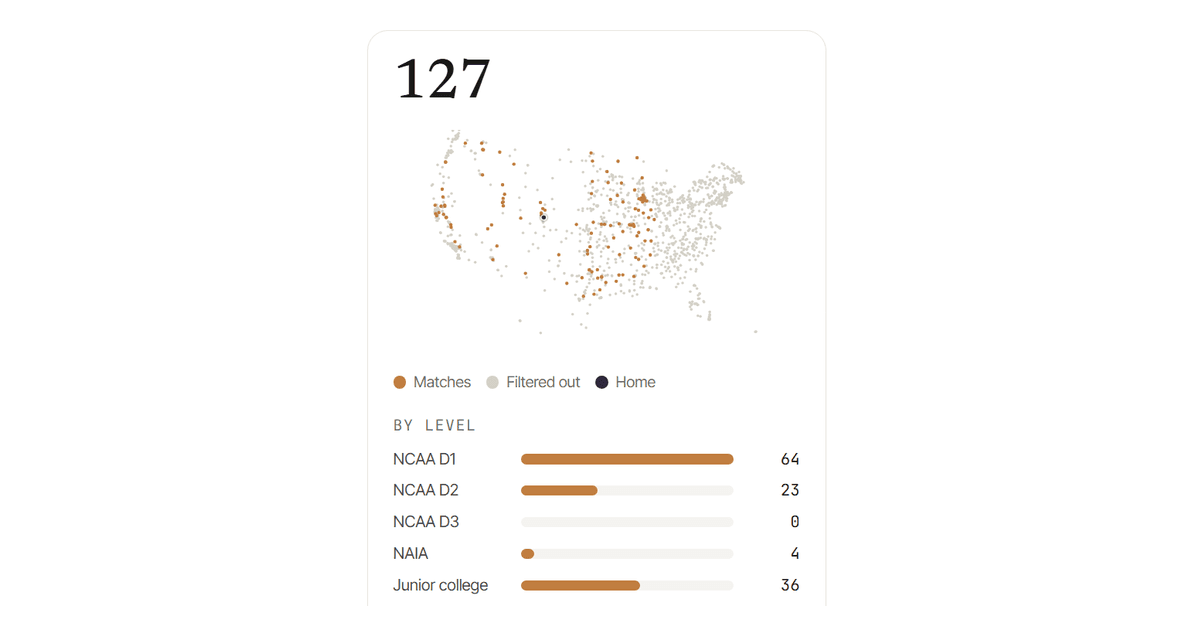
Find Your Fit is these seven questions, one at a time, with a map of the country beside them.
Every program sits on that map and it redraws on every tap. Schools that still fit stay lit, schools your last answer ruled out fade back, and your own home is marked, so “a short flight” stops being an abstraction. Underneath, the count moves with you: how many schools still fit, how they split across D1, D2, D3, NAIA and junior college, and which conferences you have the most of.
So you watch the list take shape while you are still deciding. Answer the size question and the map thins out. Change your mind and it fills back in. Your answers save as you go.
And none of it is permanent. A school that does not fit today is filtered out, not deleted. Change an answer in junior year, which you probably will, and every school that answer was hiding comes straight back. You are not going to miss a program you would have loved by answering honestly now.
Two things it deliberately does not do. It does not score any school, and it does not rank them. It only decides which ones appear. Programs that pass every filter but are missing a piece of data stay on the list and get flagged, because an unknown is not a disqualification.
The schools still showing are not your list yet. They are the pool your list comes out of. What you do next, school by school, is the subject of the next post.
Recruiting is hard. This part doesn’t have to be.
Free to look around: build your profile, browse every program, and answer your negotiables. Subscribe when you are ready to contact coaches.