Your List Isn't One List. It's Two.
Ask a family what matters in a college and you get one list. It is really two: the non-negotiables that decide which schools show up at all, and the negotiables you go and find out at each school still on your list.
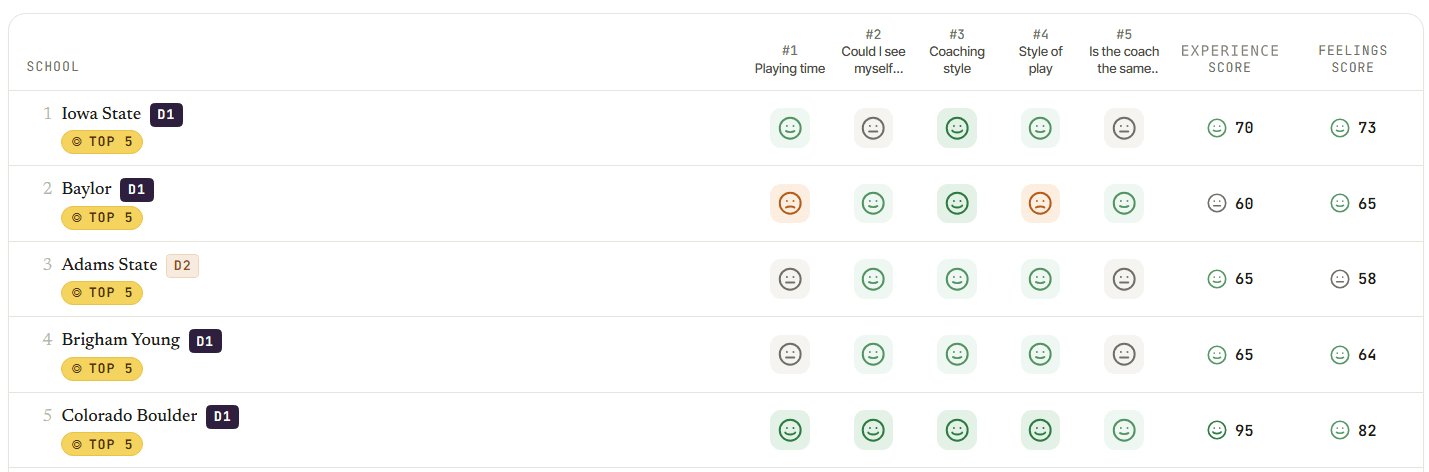
Ask a family what matters in a college, and you will get one list.
It usually sounds like this: not too far from home, a good coach, a strong business program, a place where I will actually play, somewhere warm, affordable, a team I like, and a school with a real campus.
Eight items. Every one of them legitimate. And written that way, that list cannot do anything for you, because it is two completely different kinds of thing stacked on top of each other, and the two kinds need to be used in opposite ways.
The two kinds
Non-negotiables decide which schools show up at all. Facts about a school that are true before anybody visits, calls or researches anything. Size. Distance. Division. Public or private. Cost. Climate. You can look them up, they are the same for every family, and they do not change based on how a conversation goes.
A non-negotiable is a filter. It answers one question: is this school even in the conversation?
Negotiables are what you go and find out at each school still on your list. Playing time. Coaching style. Whether the coach is the same person after you commit. What the team is actually like. Whether the academic support is real.
These are not facts you look up. They are things you learn over months, from film, from visits and calls, from the players already on that roster, from your club coach, and from older girls out of your own club who are already playing at that level.
A negotiable is a research assignment. It answers a different question: now that this school is in the conversation, how does it actually feel?
To sort your own eight items, ask one question of each: could I look this up right now and get the same answer as every other family? Yes makes it a filter, settled once and applied to everything. No makes it research, found out one school at a time, and your answer will be different from the next family's because it should be.
Why mixing them wrecks the process
Put "a good coach" in the filter list and watch what happens. You cannot filter on it, because no database has a column for it. So either it quietly does nothing, and you have a priority you believe you are acting on while actually ignoring it, or somebody starts guessing and rules out programs on a highlight clip, a message board, or a two-minute impression at a showcase. That second one is elimination dressed up as research.
Now go the other direction. Put "within six hours of home" in the research list. It filters nothing, so you spend three months on programs that were never geographically possible, fall for one of them, and your family has a hard conversation in January.
Both mistakes do the same thing: they put the work in the wrong place. You re-decide something at every school that you should have settled once, and you guess at something you should have spent months finding out.
The hardest one to place
"Will I play?"
Families want this to be a filter, because it feels like the most important thing and it would be convenient if a database could just tell you.
It cannot. What you can do is turn it into research you can perform. Count the players at your position in your class and the classes around you on the roster. Ask the coach how many at your position they are recruiting in your year, and how many underclassmen got real minutes last season. Then ask the players already there, who will tell you the truth in a way a coaching staff may not.
"Will I play" is not a question you answer. It is a question you investigate.
This is the part we built
Everything above you can do on your own, with a notebook and enough discipline to keep it current for two years. Most families start exactly that way.
Most families also stop, and not because they stopped caring. Twenty-eight questions across twelve schools is a few hundred answers, gathered over two years, by a teenager who also has school, training and a season. No notebook survives that.
So here is how HustlPlay handles this half of the list.
Pick your top ten, and what the ranking actually does
There are 28 negotiables worth knowing about a program, grouped into soccer, school, campus life, money, location, and one gut check. Research as many as you can at every school on your list. Ten is the floor, not the target.
Then rank your ten, with you doing the ranking.
Here is the part worth being precise about, because families assume something that is not true. Ranking something number one does not make it count for more. It does not weight a score and it does not hide a school. What it does is decide what gets pointed out to you, and what shows up first when you compare schools side by side.
If playing time is your number one and you have not rated it at three of your top five schools, that is a gap worth knowing about, and a ranked list can surface it where an unranked one cannot.
Parents: the ranking has to be hers, including the parts you would have ordered differently. If money is your number one and her number eight, that is a conversation worth having out loud, not a list worth quietly rewriting.
Where each answer lives, and who to ask
Every one of the 28 tells you what it is getting at and where to go looking. Some you can find on your own:
- the school's own site, for majors, class sizes and cost
- the athletics homepage and the women's soccer team page, for the roster, the schedule and how last season actually went
- full game film rather than a highlight reel, if you want to see how they really play
Others you have to ask a person, and this is where families leave the most on the table. Your resources are much wider than one coaching staff:
- the college coach, for your position, the class they are building, and what they expect
- the players already on that roster, who will describe the culture the way it actually is
- your club coach, who talks to college staffs and has watched players go through this
- older girls from your own club who are already playing at that level, and who will give you the honest answer to a question you would be nervous asking a coach
Rate it while it's fresh
When you learn something, you rate it with one tap: five emojis running from a big smile to a frown. Love it, like it, it's okay, not really, nope. "Haven't found out yet" is always there, and it is not the same as a bad rating.
Those ratings add up to a Feeling Score for that school. Not our opinion of the program. Yours, recorded while it was fresh.
Then the second one. After anything real happens, a call, a text exchange, an ID camp, an official visit, you rate the experience the same way, right after, while you still remember how it felt. Those build an Experience Score.
Two scores, and the gap between them
We show them side by side and never blend them into one number, because the distance between them is the most useful thing on the page.
A school can come back with a Feeling Score of 73 and an Experience Score of 100. What you learned reads good, not great. Every time you have actually dealt with them you have come away lit up. That is a program worth more attention than its Feeling Score alone suggests, and one combined number would have hidden it.
The reverse is the one that saves you. High Feeling, low Experience means the program reads perfectly and leaves you flat every time you deal with it. Most families feel that and talk themselves out of it, because everything they researched says great fit.
A number cannot show direction either, so the Experience Score carries a trend: rising, steady, or cooling. A school where the first call was a big smile, the camp was fine and the last two check-ins were flat still averages out respectably, and the direction tells you what the average hides. Cooling does not always mean the program lost interest. Sometimes it means you did, and you have not said it out loud yet.
One more rating sits on those check-ins, and it is your parent's. They add their own, either alongside yours in the moment or from their own account afterward, and it is never averaged into your score. The goal is not a family consensus number, it is to make the difference visible. A visit you rated love it and your mom rated it's okay is a conversation that would otherwise never have happened.
What we will not do
Plenty of recruiting products will take your preferences, run them through a formula, and hand you a number for how well a school fits you. 87 out of 100. A strong match.
We are never going to do that. A match score is a prediction about a school you have not met, generated before you learned anything, and it arrives sounding more certain than it has any right to. A Feeling Score is a record of what you said after you went and found out.
The difference that matters is who gets to be right. A match score that disagrees with you invites a sixteen-year-old to assume the computer knows better. A Feeling Score cannot disagree with you, because it is made of you.
Recruiting is hard. This part doesn't have to be.
Free to look around: build your profile, browse every program, and answer your negotiables. Subscribe when you are ready to contact coaches.